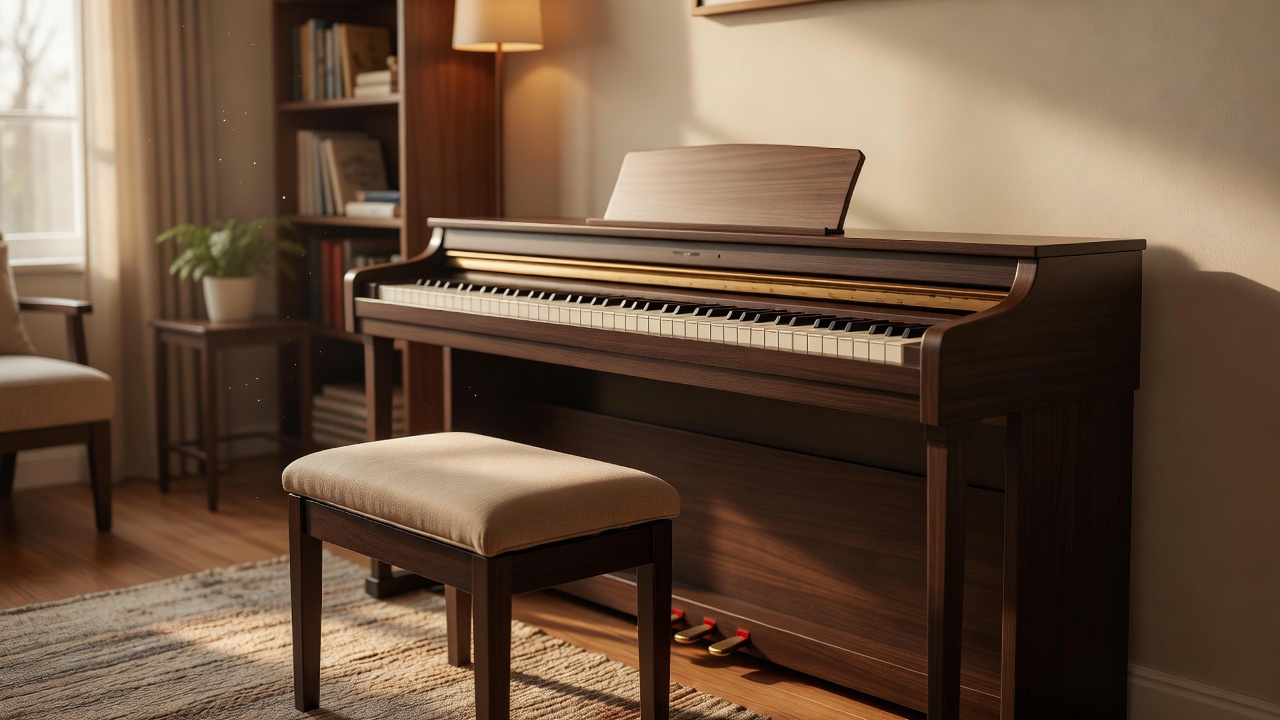
Measure the whole playing station
Begin with the seat, not the specifications. You need room for your knees, relaxed elbows and an easy route into the playing position. A keyboard balanced on a dining table may sit too high, encouraging raised shoulders. A stable stand and an adjustable bench can make a modest instrument much more usable.
Imagine practising after work while someone else uses the room. Where will the power cable run? Can the music rest stay attached? If you must pack everything away, check the instrument's weight and how safely you can lift it. “Portable” describes a category, not a guarantee that carrying it will suit your body.
Choose the kind of keyboard experience
An acoustic piano produces sound through strings struck by hammers. A digital piano uses electronic sound generation and usually aims to reproduce a piano-like playing experience. A portable keyboard may prioritise lighter weight, built-in accompaniment or a wider selection of sounds. These categories overlap, so read the actual specifications rather than relying on the label.
| Route | Useful when | Check first |
|---|---|---|
| Digital piano | Piano technique and volume control matter | Key action, pedals and headphone connection |
| Portable keyboard | Storage and exploring sounds matter | Key size, touch response and stand stability |
| Acoustic piano | A permanent playing space is available | Condition, moving access and tuning support |
A standard full-size piano has 88 keys. A smaller keyboard can still support early exploration, but some repertoire and teaching approaches will eventually need more range. If you want to study piano specifically, discuss key count and action with a teacher before buying. More buttons are not a substitute for a suitable playing surface.
Understand touch without chasing labels
Touch sensitivity means the instrument responds to how you play a key, often by changing loudness. Weighted action describes resistance intended to resemble aspects of piano touch. They are different features: a keyboard can respond to playing force without feeling like an acoustic piano.
Compare a few instruments with the same simple task. Play repeated notes gently, then more firmly, and notice whether you can control the result without tensing. Yamaha, Roland, Casio and Kawai all make keyboard instruments, but a familiar manufacturer name does not identify the right model or condition. Comfort, reliable operation and your intended lessons are more useful tests.
Headphones solve only part of the sound question
Digital instruments can send their electronic sound to headphones, which is helpful in a shared home. The keys and sustain pedal still make mechanical noise. Vibrations may travel through a stand or floor, especially late at night. Ask another person to listen from an adjoining room while you play normally.
Use comfortable headphones at a modest level. Increasing volume to cover outside noise is not a safe long-term solution. Check that the instrument has an appropriate headphone output; a USB port alone does not establish that ordinary headphones can connect directly. Also confirm whether inserting headphones automatically mutes the speakers.
Make the first sessions specific
Start by finding groups of two and three black keys and locating nearby notes. Then practise a short pattern with one hand while keeping the other relaxed. Reading music, matching notes by ear and coordinating two hands are related but separate skills. You do not have to introduce every challenge in the same sitting.
A metronome provides a regular pulse, but it should not turn a new movement into a race. Learn the movement slowly first. If you use exercises from Charles-Louis Hanon's The Virtuoso Pianist or Béla Bartók's Mikrokosmos, ask a teacher which material fits your current ability rather than assuming every page is beginner-friendly.
Keep ownership uncomplicated
Digital pianos do not require acoustic tuning, but their keys, connectors and electronics still need sensible care. Follow the manufacturer's cleaning guidance and avoid spraying cleaner into the mechanism. Acoustic pianos need professional attention and an environment protected from severe temperature and humidity changes. Their condition cannot be judged from a polished cabinet alone.
The most useful first instrument is not necessarily the one with the longest feature list. It is the one that supports comfortable practice now, fits your musical interests and has a realistic place in your home.
Terminology: sustain, action and polyphony
Sustain lets notes continue after you release the keys, usually controlled by a pedal. Action is the mechanism and feel of the keys. Polyphony is the number of simultaneous voices a digital instrument can generate; layering sounds and using sustain can use more voices than the number of fingers playing.